Gusto
How Gusto's CX team is building the next best advocate-assisted experience — and doing it faster with AI
Unified Service Platform
Gustie Assist: Agentic tooling for enhanced customer support
Lead PD – UX strategy, interaction design
Overview
Gusto's Customer Experience organization supports hundreds of thousands of small business customers across payroll, benefits, tax, and compliance. Advocates handle cases across chat, email, and voice — often switching between six or more tools in a single interaction. Otto is Gusto's AI-powered advocate assistant, embedded in Salesforce. It surfaces case context, knowledge, and AI-generated guidance without requiring advocates to leave their workflow.
The thesis: the advocates who deliver the best customer outcomes aren't the ones who know the most — they're the ones who can access the right information at the right moment and act on it with confidence. Otto's job is to make every advocate, regardless of tenure, capable of that.
Research
The advocates we design for
Otto serves a fundamentally split user base. Tenured advocates carry years of procedural knowledge and adapt to almost any situation. Newer advocates are still ramping — they know the product exists but can't always find the right answer fast enough to keep pace with a live customer. The same interface has to work for both.
Cross-functional UXR surfaced four CX archetypes that shaped the platform's information architecture. The key finding: newer advocates don't need less information — they need more structure around it. Tenured advocates need tools to go faster. Both needs can be served from the same surface if it's layered correctly.
Opportunities + Challenges
The fragmentation problem
Gusto's CX organization runs across multiple Salesforce instances: PayOps, TaxOps, BenOps, Risk and Compliance. Each domain has its own tooling, its own routing logic, and its own version of Otto's capabilities. Advocates who handle cross-domain cases carry the cognitive overhead of switching contexts.
The opportunity: Otto as a harmonization layer. A single surface, consistent across domains, that consolidates the tools advocates need — case routing context, related case history, domain-specific tools like Panda and Hippo — without requiring a new Salesforce configuration for every use case.
Scaling across domains
The franchise model — extending Otto to new domains by adding targeted toolsets and context-specific knowledge — is how the platform scales without rebuilding from scratch. Each domain expansion is a feature launch, not a platform rewrite.
The vision
In Q4 2025, I led the creation of our vision that reinvents how customer service is done at Gusto. The advocate experience is singularly focused on one goal: to get the customer back to focusing on making their business successful – not on the problems surrounding their business. In this journey, Otto assists TaxOps in resolving a customer issue quickly and efficiently, while continuously building the capabilities necessary to do this for thousands of customers at scale.
The design vision for what Otto becomes as a platform is ambitious: not just an AI assistant, but the harmonization layer — the single surface advocates use across every internal domain and every channel, regardless of the complexity of the case in front of them.
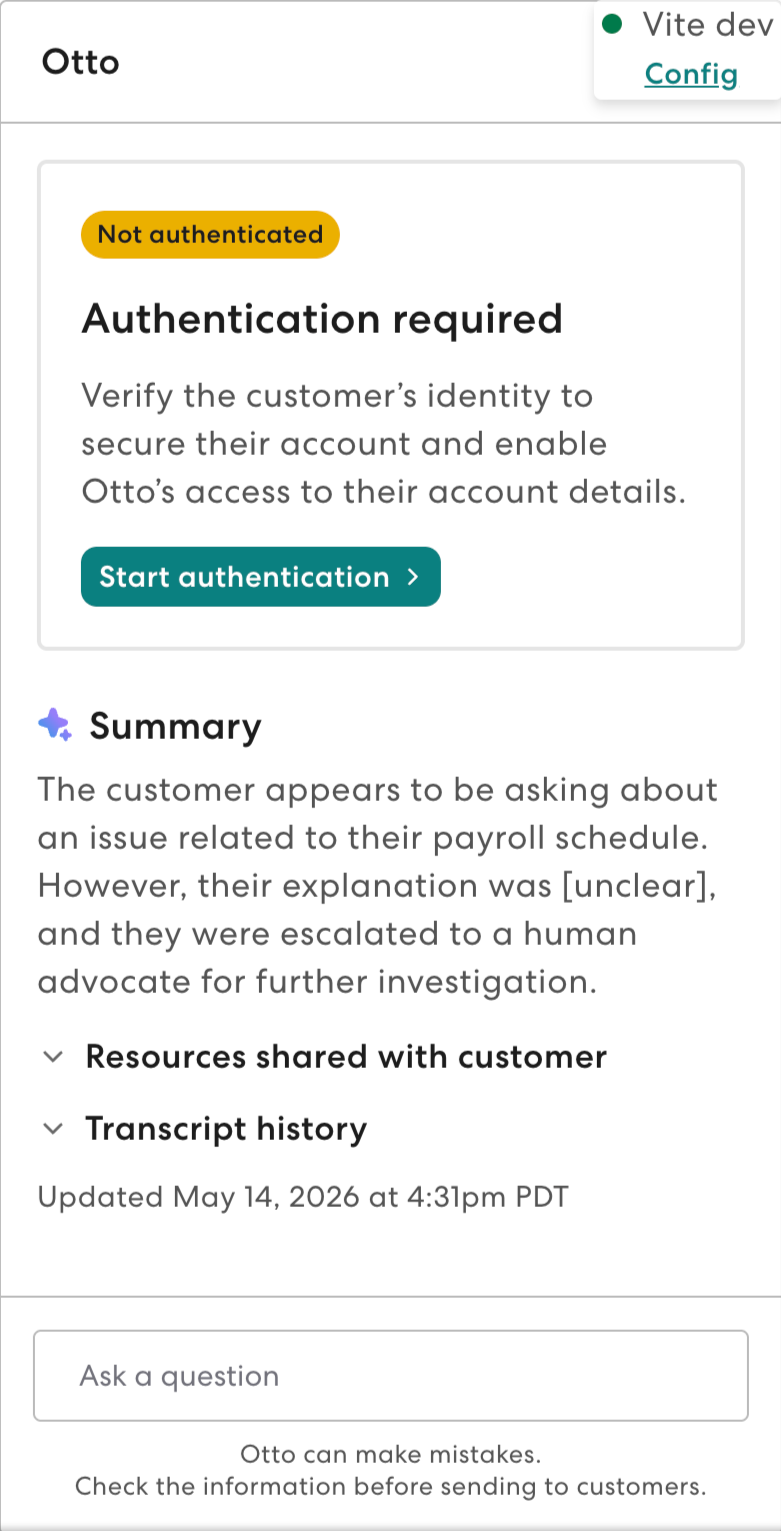
Otto in its current configuration shortly after MVP rollout.
Building with AI — in product
and process
AI in the product
The focus on the Otto roadmap is AI:
AI Accelerates — AI supports the workflow; human judgment drives the outcome with increased velocity.
Maximum AI — In nearly every process and feature, AI is present to assist the associate in providing the right context, the right recommendations, adaptive responses and reduction of time spent typing responses manually.
AI in the process
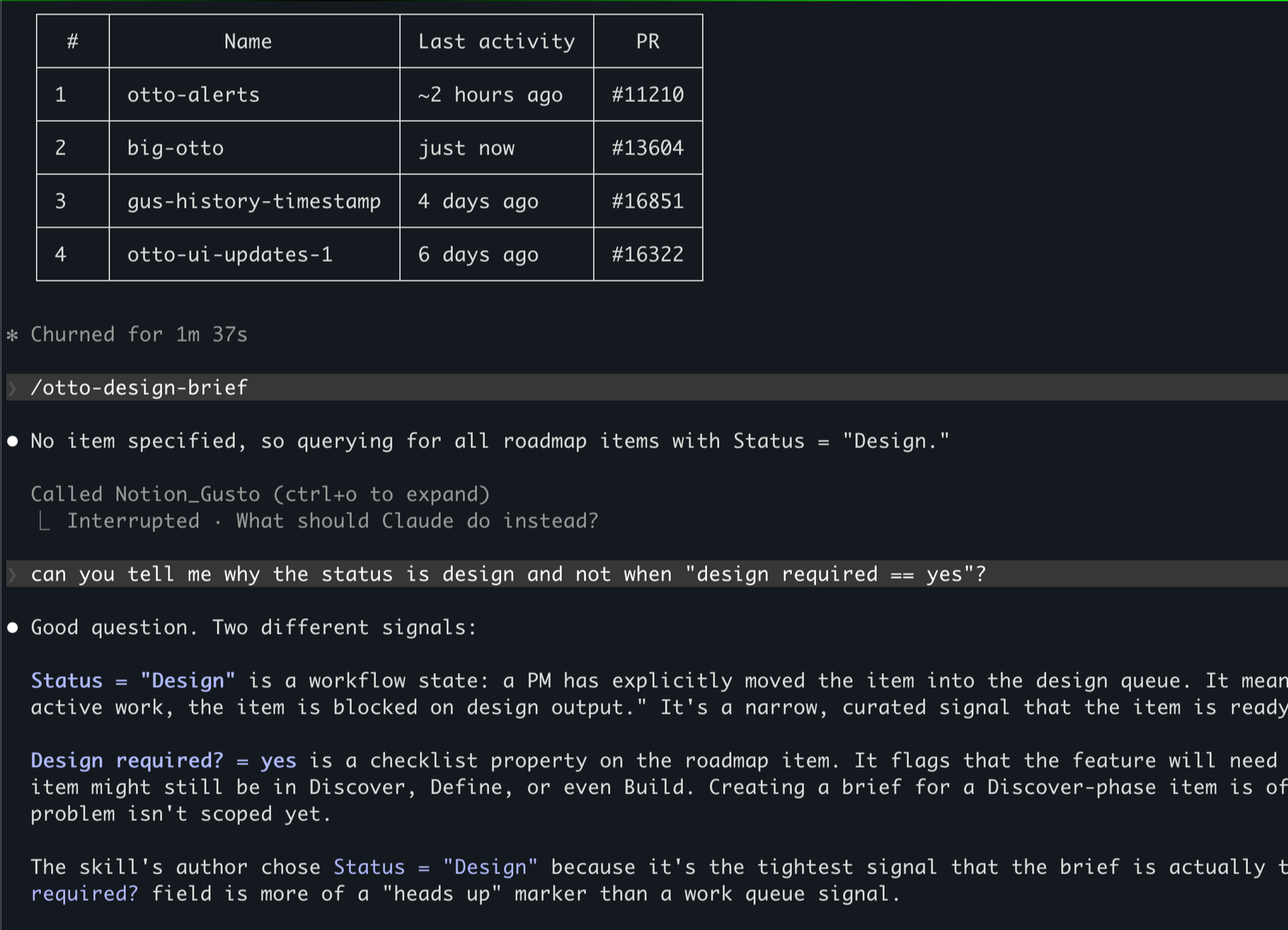
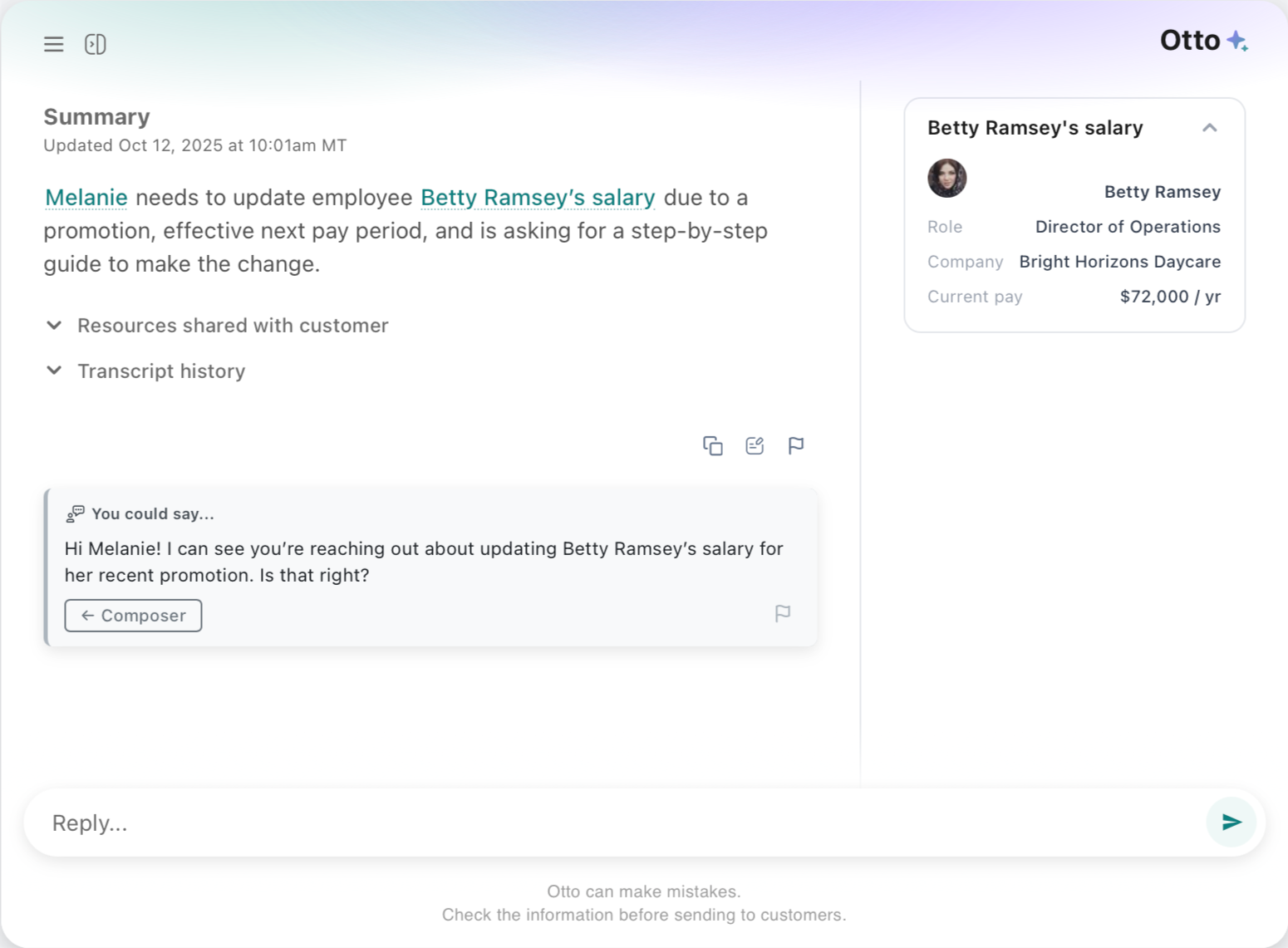
The Big Otto prototypes weren't mocked in Figma. They were built in React, using the same design system tokens and component architecture as production, and shipped directly to the engineering repository. That distinction matters.
When a design decision lands in a PR instead of a static file, it's immediately testable. Engineers can run it, interact with it, and raise implementation concerns before a line of production code is written. The feedback loop shrinks from weeks to days.
This approach also produced something unusual: a design backlog that runs 1–2 development cycles ahead of engineering. While engineers are building FY27 Cycle 1, the prototypes for FY27 Cycle 2 features are already reviewable. The same capacity that would have been spent on iteration and clarification is instead spent on advancing the roadmap.
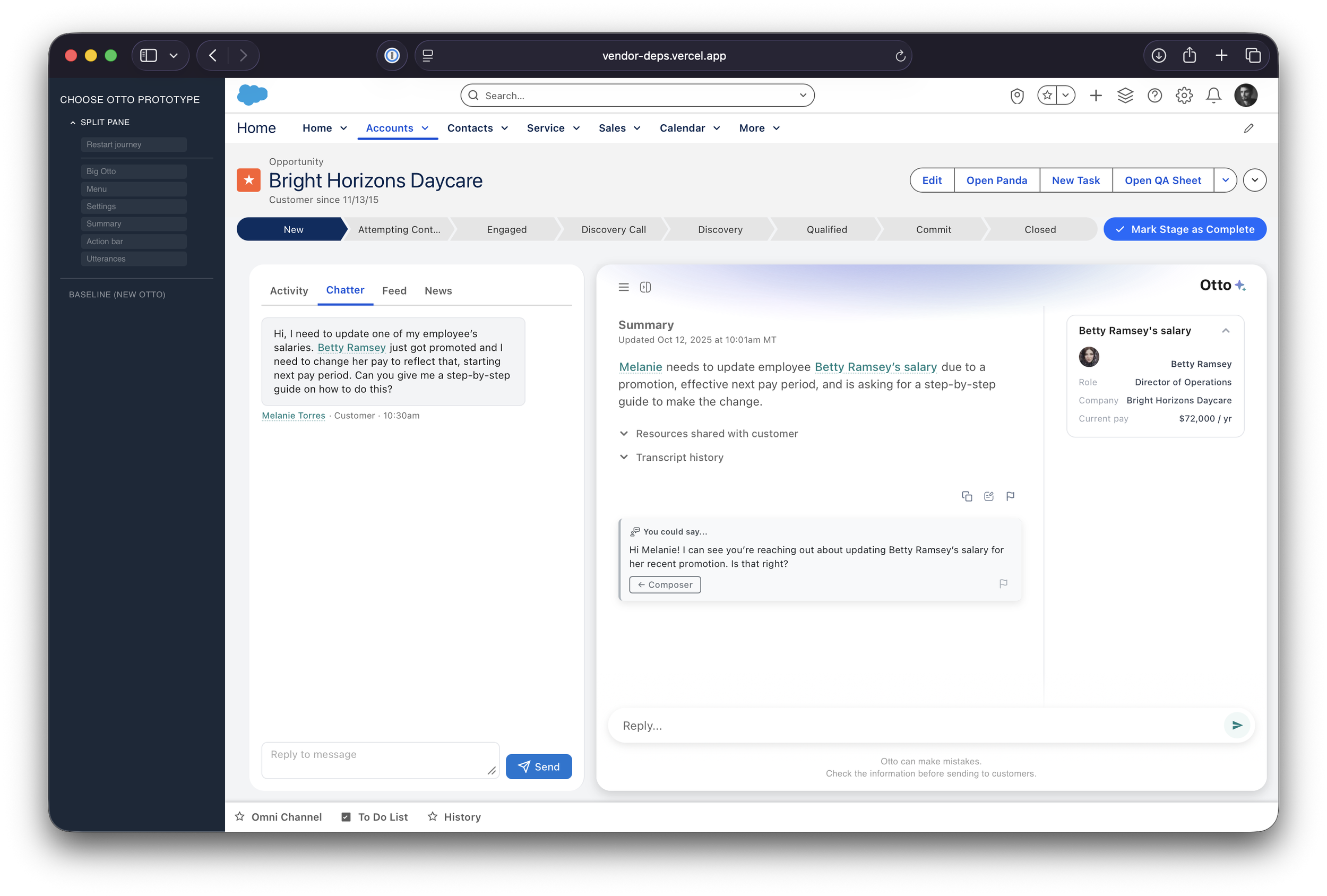
In this prototype you can view several of Otto’s roadmap features in one cohesive space – so the team knows exactly what we’re marching towards.
It uses real design system components, interaction states, toasts, error variants, and accessibility-aware markup.
Features include:
Expandable workspace
Context cards
Utterances
Contact summary
Quick actions
Streaming transcript with continuous processing
Feedback flywheel for always-on model improvement
Prototype: Otto’s roadmap
Outcomes
What's out now
Otto was released in Q4 2025 and is able to provide RAG responses based on internal and public knowledge bases, removing the need to search those repositories publicly. Within the last month, Gusto has released the newest AI platform that will power Otto and integration will occur in the current engineering cycle (May 2026) – giving Otto the capabilities that will turn prototype into reality.
What's actively being built
FY27 Cycle 1 has the heaviest simultaneous load in the roadmap:
Otto Franchise: BenOps, TaxRes, Risk and Compliance — three domain expansions running in parallel (PayOps queued behind them)
Show Me How POC — guided in-product walkthroughs
BenAgent Opportunity integration
Otto Drawer full-height panel — surface area expansion
Agentic Workflow Enablement POC — the foundation for Otto acting on behalf of advocates, not just informing them
What's designed and queued
The design backlog for FY27 Cycle 2 and beyond is prototyped and production-ready:
Pre-Composed Replies and Talking Points (Whisper)
Adaptive UI in Otto responses
Show Me How — productized walkthroughs
Cross-channel context via CRP integration
Proactive tool and workflow suggestions